Thursday, January 3, 2019

Eos At Dawn

Eos At Dawn
(Sdlg# NGCIMP3)


2019 - Reeder - Tetraploid - 
Notify Ground Crew x Implausibility - 
65” scape - 5.5” flower - 4 branches - 20 buds - Early-early - Dormant

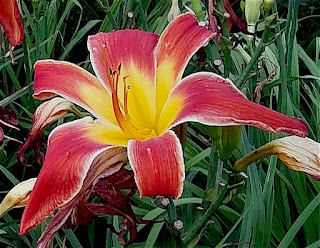
China red with pale pink-white midribs and slightly darker red band above golden-yellow throat.

For a complete list of available daylilies and pricing, click here.


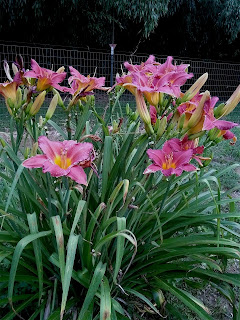
In Greek mythology, Eos is a Titan and the goddess of the dawn. I thought it was an appropriate name for several reasons. This cultivar is the earliest flowering tetraploid I grow, flowering in the range of Stella De Oro. It is also an early morning opener and opens well on cool mornings, starting both the season and each day with beautiful, bright sunrise-red flowers. The plant is large with tall scapes, making it a titan of a daylily. It showed extremely strong rust resistance through all five years of my rust screening, making it a five-year tested A+, and it shows very high thrip resistance, which is exceptional for these early-early flowering plants in my garden. The plant also shows excellent resistance to late spring freezes. In my garden, early-early cultivars are notoriously problematic, both for thrips and late freezes. Early-early types frequently show scapes much shorter than the registered height, extensive bud drop and thrip damage, and some just have their scapes dry up and fall over. This cultivar though is notable here for rarely doing any of this, only showing slight damage to foliage from late freezes, but never reduced scape height. While thrips will cause some enations on the outside of the bud, the flower itself holds up without heavy spotting or damage. Finally, it is extremely fertile both ways and is the mother of many seedlings in my program.


A seedling from my 2011 breeding season, Eos At Dawn has a very interesting parentage, bringing a host of new genetics into the hybrid tetraploid population. Both of the parents are species/species-like base plants in my program. It combines the best of both parents and actually advances several of their best traits, flowering earlier than both parents, with even better late-freeze, rust and thrip resistance.


The plant shows attractive foliage of a medium green tone and tall scapes averaging around five and a half feet. The branches average between four to five on mature fans within mature clumps. The new divisions and young fans will tend to have shorter scapes at around four feet and with two to three branches. For an early-early cultivar, its resistance to various problems, bright color and great performance make it a stand-out in the garden. The foliage is senescent and shows dormancy in my garden. The plant has been very hardy, never showing any serious damage from harsh winters or late spring freezes. It is this plant that is responsible for me deciding to go ahead and pursue and early flowering tetraploid program.


In addition to its excellent plant traits, Eos At Dawn is also an excellent parent. Very fertile both ways, it is an excellent tool in improving early-early tetraploid lines. It shows very good breeding value for both its high rust and thrips resistance, as well as its tolerance to late spring freezes, and it passes its large plant and tall scapes on to many of its seedlings. Below are some if its seedlings in my program.

2022 Update

This year I have the first two introductions deriving from Eos At Dawn.

Astraea
(Eos At Dawn x Pacific Rainbow)

Titan Goddess
(Welding The Titanic x Eos At Dawn) x Wookie Goddess


The two seedlings above are from crosses of Eos At Dawn with Whooperee, which is only slightly later flowering that Eos and shows equally high rust resistance with even higher thrip resistance. The results of that cross were phenomenal for resistance to the problems seen in so many of the early cultivars. The flowers show a lot of interest as well, demonstrating that Eos can produce seedlings with more advanced flower traits than it shows. The seedling below is from Eos crossed to Pacific Rainbow. It too is an excellent plant and flower, showing the potential that Eos has for use in early programs with colors beyond red. As of 2022 this seedling is the introduction Astraea.


The image above is from my 2018 Monday Night Lights presentation on Facebook (click for larger image). It gives some information about the plant when it was a simple seedling. The bud count mentioned in the image is for the upper end of established clumps. I registered it as less to reflect the average bud count.

The images below show the cultivar over the years in the garden, from 2013 through 2018. It is an impressive display and I think it has a big future for improving early flowering lines for use in cold-weather climates, as well as improving rust resistance in such lines.


Eos At Dawn shows strong rain and sun resistance. Here after a hard downpour.


Here you can see the wonderful branching on the scapes.

As an example of how early it is, here you can see that Eos is the only cultivar in bloom in my hybridizing garden.

And here it is from the opposite view again showing that nothing else is yet blooming in my hybridizing garden while Eos has already started her show.

Wookie Goddess

Wookie Goddess
(Sdlg# WWIMP5)


2019 - Reeder - Tetraploid - 
Wild Wookie x Implausibility - 
48” scape - 7” flower - 4 branches - 18 buds - Early-Midseason - Extended - Semi-evergreen - UF-pinched/twisted/crispate


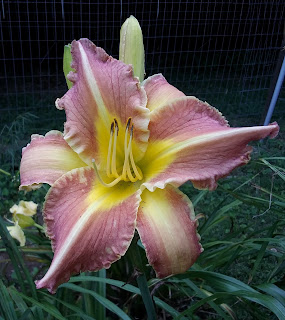
Bright, China red with cherry red band and petal edges above olive green to chartreuse throat.
For a complete list of available daylilies and pricing, click here.


A seedling from my 2011 breeding season, Wookie Goddess went through all five years of my rust resistance screening program showing extremely high resistance each year, making it a five-year tested A+. It also shows high thrip resistance. A semi-evergreen, it is very hardy here and shows no damage from hard winters. As a semi-evergreen, it should also thrive for people in warmer-winter areas, allowing people to exploit its high rust resistance in evergreen breeding programs for hot climates, as well as allowing breeders in cooler-winter climates to make use of it. It shows moderately high resistance to late spring freezes, generally showing no decrease in scape height. I expect it will also do well in colder zones than mine.


The foliage is medium green and attractive, but can show slight damage from late spring freezes. The scapes are consistently tall, around four feet on mature clumps. The scapes show nice branching. I registered it with four branches, though I have seen it with as many as seven, but it averages four to five. The average bud count is 18 to 20, but I have seen mature scapes with as many as 29 buds. New divisions and immature fans may show two to three branches with scapes at around three feet and about 15 buds. The plant recovers quickly from division and shows good increase. The flower is an extended opener, like its pod parent, opening over the course of two days. Yet the thrip resistance is strong enough that this trait doesn't cause it problems by allowing thrips and other pests into the flower during the opening process. 


The flower is a lovely UF form, often pinched and with quilled sepals, sometimes cascading, that opens well and tends to open very flat. The color is extremely bright, carrying across the garden on the tall scapes. The eye and edge can be very subtle, but are generally present on mature clumps. The throat is chartreuse, which is a nice step up from the pod parent's orange throat. The genetics of this plant include species genetics from H. fulva 'Europa', through the pollen parent, Implausibility. This opens the very narrow UF tetraploid gene pool, adding diversity from the species grandparent. Wookie Goddess is very fertile both ways, with strong pod fertility. On a mature clump, I have been able to set nearly every flower in the plant. This is an outstanding trait in tetraploid UF lines, as many of these show poor pod fertility. I think Wookie Goddess is an excellent plant for the garden, but it also has great breeding potential for tetraploid UF programs, offering many excellent traits to blend into such lines, both for cold-winter climates and warm-winter climates. I have many seedlings from WG, and she really gives great results. Many seedlings are very rust resistant, many show excellent thrip resistance. I have seen both dormant and semi-evergreen seedlings, and these have tended to be quite hardy, far hardier than the seedlings from the pod parent Wild Wookie. 


Wookie Goddess is an excellent breeder for many traits. The above slide from my 2018 Monday Night Lights presentation on Facebook shows an excellent red seedling from Wookie Goddess, while the seedlings below is from Wookie Goddess crossed with pollen from the Alien family line by Bob Selman. I have seen a wide range of seedlings and am impressed by the many different faces I have seen from WG. Many of its seedlings also tend to open very flat and I have been exploiting this trait in my breeding work with this plant.


The slide below, also from my 2018 MNL presentation, gives some details on Wookie Goddess while she was still just a numbered seedling.


A flower from a new division that had been divided and replanted the previous fall.


Yes, it does have stamens, but I did use it a lot in breeding that year! :-) This picture shows the open form and green to chartreuse throat.

Contemplation Of Chaos

Contemplation Of Chaos
(Sdlg# JSEOC74)


2019 - Reeder - Diploid - 
Joan Senior x Edge Of Chaos - 
38" scape - 6.5" flower - 3 branches - 16 buds - Midseason - Semi-evergreen - Fragrant

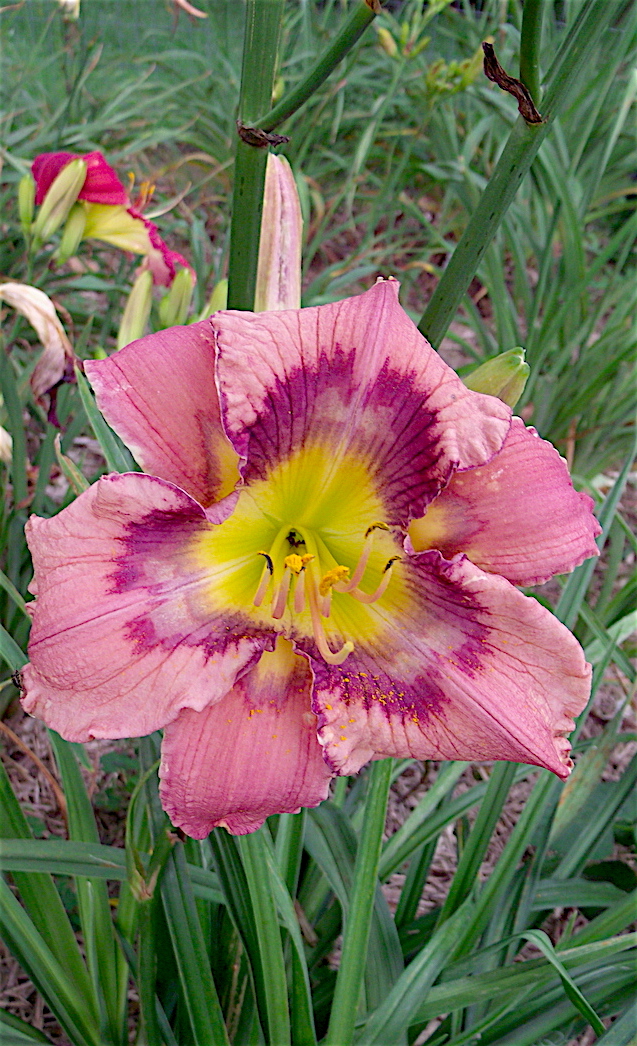
Clear medium purple self above green to chartreuse throat.

For a complete list of available daylilies and pricing, click here.


Contemplation of Chaos is a lovely purple flower with very rich, bright and clear color, with the old classic Joan Senior as pod parent and the illustrious Mahieu cultivar Edge Of Chaos as pollen parent. The flower alone would be enough to consider this one for introduction, but the extremely high rust resistance through all five years of my rust resistance screening program is what closed the deal for me, marking this introduction as a five-year A+. Purple daylilies with extremely high rust resistance are extremely rare, so as the years of growing this seedling passed, and it was clear colored and extremely rust resistant year after year, I knew I had to get this one out to the public. 

In addition to the great ancestry and the exceptional resistance, Contemplation Of Chaos is a semi-evergreen so should grow well in warm-winter climates where rust is a big problem and it is extremely fertile both ways. It has produced many very nicely colored seedlings with extremely high rust resistance to me and has repeatedly shown strong breeding value for rust resistance, as well as for very bright, clear and pastel colors - pink, purple, lavender and near white. It is important to me to get this one out to the public where people interested in rust resistance can also take advantage of the rare combination of traits this cultivar offers.


But wait! There's more! 
Contemplation Of Chaos is a nice plant, showing medium green foliage and a large plant that is attractive in the landscape. It is also a fast increaser that clumps up quickly and makes a lot of fans that don't quickly crowd out in the middle allowing it to be either frequently divided for increase or left alone to form a big, glorious clump that gives good performance for a long period of time. The scapes are a good height, though I would like to see more branching, but with a plant with this level of resistance and the very clear purple flower, some things can be forgiven. However, I would note that I have gotten many seedlings from it that show better branching, so you can make good use of it in breeding to improve rust resistance and maintain good branching in a line. As with branching, bud count could be higher, but the same reasoning to look over that point applies. It is too important for the rare and desirable traits is has to dismiss for one or two traits not being the maximum we look for in our modern daylilies. The thrip resistance is moderate.


The form of the flower is very lovely. It is not a UF, but just a normal open-form flower, but it can be used successfully in UF breeding, having produced narrow and UF seedlings for me. The ruffling of the flower is gorgeous and is strong on both petals and sepals making the flower look very modern and fancy for a simple self-colored flower. The flower holds the green throat quite well all day and shows good resistance to rain and sun. The texture of the petals is good, and doesn't melt down by evening. The green throat and the flower substance passes to many of its seedlings. Being very pod fertile, it is very easy to create a lot of seeds on this one. I have made pods on every flower several years in a row and never saw that harm the plant, cause poor increase or suppress the flowering in the following year. This one has been a powerhouse mother plant for me and I think it can be for many other breeders. While it is a semi-evergreen, and should do great further south than my garden, it has been very hardy here, never showing any severe winter damage, so I suspect it will also do well in colder climates than mine. While people in the north may not be concerned with rust resistance, I think the lovely flower and its high breeding value for color combined with high fertility and hardiness mean it would be a boon for northern UF and Purple diploid programs.

Below are three seedlings from Contemplation Of Chaos.

Sdlg (Contemplation Of Chaos x Ziggy Played Guitar)
On first year flower in a 20 gallon seedling tub. The bluish edges of Ziggy are even more intense in this interesting and bright seedling.

Sdlg (Heavenly Angel Ice x Contemplation Of Chaos)
A surprise! The eye is one of the bluest I have ever produced. There is also pattern in the eye on most flowers, the throat is very green and the entire flower is very nicely colored with very clear tones. This one went through the last two years of my rust resistance screening and has shown very high resistance and is still in testing. I think this one really shows the great possibilities that come from Contemplation Of Chaos used in breeding.

Sdlg (Vorlon Encounter Suit x Contemplation Of Chaos)
The purple color of this seedling is extremely bright and clear, though of a darker tone. The throat is very green. I don't care for what the sepals are doing, but the coloring is very rich and the rust resistance tested very high for the last three years of my testing program. I include it to show the intense color and the wider petals to show that Contemplation Of Chaos can be used in round flowered programs as well as in narrow or UF programs.


The picture above, of Contemplation Of Chaos, is a flower from its very first year of flowering in my garden. It was pretty from first flower and has remained an eye-catching flower flower and has proven to have many fine traits for a garden plant and as a breeder.

Elizabethan Fantasia

Elizabethan Fantasia
(Sdlg# AZHDLAM1)


2019 - Reeder - Tetraploid - 
Aztec Headdress x Larry Allen Miller - 
32” scape - 5” flower - 4 branches - 15 buds - Early Midseason - Rebloom - Semi-evergreen


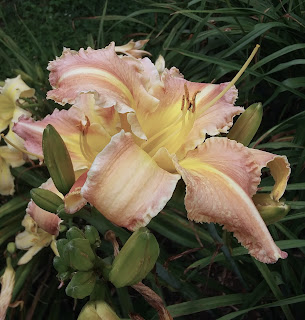
Reverse bicolor of pink to lavender, midribs the color the darker sepals with dark purple eye showing broken patterns of paler pastels and thin double edge of dark purple with lavender-white wire edge.

For a complete list of available daylilies and pricing, click here.


This incredible plant is from seeds I bought off the Lily Auction in 2010.  From the first flower, I have suspected it would be an introduction. While it only shows moderate rust and thrip resistance, it is a great grower, a hardy semi-evergreen and an excellent breeder, and the flower is very interesting. I haven't personally seen or grown anything like it, except for some of its seedlings. The patterned eye is variable, but there is almost always some pattern, even if rather faint and it repeats in the sepals. Most days sees a nice amount of broken pattern in the eye and the pattern really goes crazy in cool weather. In hot weather you still see pattern, but in very hot weather, it will loose most of the pattern. The throat is an extremely saturated green color and holds that color throughout the day very well and passes that throat on to many of its seedlings. The plant has attractive dark green foliage and it is a consistent rebloomer here in my garden, sometimes producing two rounds of rebloom scapes, and many of its seedlings also show this reblooming trait.


A 'fantasia' is defined as (1) a musical composition with a free form and often an improvisatory style, (2) a work (such as a poem or play) in which the author's fancy roves unrestricted, or (3) something possessing grotesque, bizarre, or unreal qualities. It originates from Greek and in Greek is a girl's name meaning 'imagination'. The changing face certainly strikes my imagination and makes me think of the flowing, changing melodies of a musical fantasia. Its pattern also reminds me of the complicated embroidery of Elizabethan needlepoint, often seen on women's gowns of the era. The color of the flower varies depending on where I grow it. In my mother's pH-neutral garden it combines very clear, bright pink tones. In my more acidic hybridizing garden, it goes to lavender tones. The pattern seems to behave the same in both gardens. The plant is very pod and pollen fertile and I have produced some seedlings from it that show dormancy. The rust resistance was extremely strong in 2012 (A+), less so in 2013 (A) and slightly less through the other three years of testing (A-/B+). The five-year average is an A, but I personally rank it as a B+, which is closer to the last three years I observed it. I have produced some extremely resistant seedlings from it when I combined it with Stare Master and with Whale Tails. There is a good bud count, and on an established clump, I have seen as many as twenty-two buds per scape.


The picture above shows a warm-weather flower with less pattern. The thrip resistance is moderately high, but in a heavily thrip infested garden, after a spring with many damaging late freezes or both, there can be some thrip damage. I have produced seedlings though with significantly more thrip resistance when I crossed it with Solaris Symmetry. The semi-evergreen plant is hardy here and the plant has never shown any significant fan loss or crown damage from even the most severe winters. The foliage will show damage from late spring freezes, but it doesn't kill the plant. I suspect it will survive in colder climates than mine, especially where there is significant winter snow cover, and I know it will thrive in warmer-winter climates, as I have had it tested in warmer climates and it performs better there than it does for me.


The form of the flower is very nice and the flower is consistently a good opener and the flower is almost always very flat. There is very little canoeing in its flowers. The reverse bitone coloring really makes the flower pop and the colors show up nicely in the garden with the green throat really standing out.


This is the flower with no broken pattern, though it still qualifies as a pattern by the AHS definition. Even if this were the way it always looked, it would still be an introduction because it is extremely attractive and has been such a good garden plant and breeder. 

The slide below shows some of Elizabethan Fantasia's seedlings.


The seedlings often show very nice, clear color and interesting patterning.
(click slide for larger image)


The slide above, from my 2018 Monday Night Lights presentation on Facebook, gives some more insight on this plants.
(click slide for larger image)

I have added multiple pictures below to show the plant at different times of day and in different parts of the season. 


Here we see a flower showing interesting pattern on the petals, along with the pattern on the sepals. This is a bloom from the first round of scapes and you can see some thrip damage, if you look closely. While it is present, you can see that it isn't severe.


Late evening near sunset


The three pictures above are of the flowers on a low pattern days in late summer, but note how strong the green throat is in these picture (and in all the ones above) regardless of the season in which the flowers occur, or the time of day. Even on this day though, there is slight patterning in the eye.


Here is a picture of the plant in spring before the first scapes have appeared. The color is a nice, dark green and looks good in the garden. The plant is a fast increaser that recovers well from division, clumping-up quickly.


The pictures above and below are from Rita Mallon who has been testing this plant for me in her Oregon garden, which is in a warmer winter climate than I grow in. A big concern in the Pacific Northwest is whether a daylily will open well after the frequent cool nights they experience in summer. Rita says that this one has opened well for her and it gave a good display for her in 2018. I just sent her a tiny little division in 2017 (I wanted to see if it could survive) and it had grown enough to flower for her in 2018. As you can see, the pattern shows well in her climate and the eye is significant darker than I usually see it, but the throat is just as green (if not more so) and the pattern looks very good. Thanks for giving this one a trial-run, Rita!! :-)


Korean Mothers Of Pink and Purple

Korean Mother Of Pink 
and 
Korean Mother Of Purple
(Sdlg#s HFKPS1 and HFKPS7) 


Korean Mother of Pink - 2019 - Reeder - Tetraploid - Hemerocallis fulva ex Korea, Seoul National University, NA 54920 x Papa Smurf - 42” scapes - 4.5” flower - 3 branches - 12 buds - Midseason - Semievergreen 

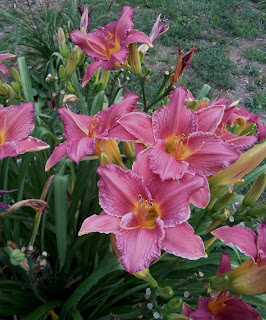
Orange bicolor with pink overlay making pink-peach petals and pale yellow sepals with pink-peach edges. Strong white midrib and slightly darker band above army green to chartreuse throat.

Korean Mother of Purple - 2019 - Reeder - Tetraploid - Hemerocallis fulva ex Korea, Seoul National University, NA 54920 x Papa Smurf - 46” scapes - 5.5” flower - 3 branches - 15 buds - Midseason - Semievergreen

Orange with lavender overlay creating an antique peach tone. Solid, darker sepals with petals showing the same color, but lighter petal edges with a darker band and paler midrib above golden-yellow throat.

For a complete list of available daylilies and pricing, click here.


I am listing these two introductions on one page because they are full siblings and much of what applies to one applies to the other. Both are first generation backcrosses of the modern tetraploid cultivar Papa Smurf as pollen parent onto the H. fulva 'Korean' clone imported by Darrel Apps and Barry Yinger in 1984, as pod parent. This fulva clone is a very fertile pod parent with pollen from tetraploid cultivars, and flow cytometry suggests it is a triploid. I registered both of these cultivars as tetraploids because I made repeated attempts to use their pollen on a wide range of diploids with no seed set, and conversely used dip pollen in these from multiple diploids, only to never get a seed. This strongly suggests to me that they are tetraploids. They are both pod and pollen fertile only with tetraploids in my experience. Both show good fertility both ways in my garden.


H. fulva 'Korean' is extremely rust resistant, in fact one of the most resistant and most consistently resistant daylilies I have ever seen, and I have reports of it maintaining that extreme resistance (really immunity) in many very rusty locations in the southern-tier states. It also shows extremely high breeding value for rust resistance, consistently producing a high percentage of extremely resistant seedlings. However, many people may be afraid to work with it as it is a fulva and so is rhizomatous. While I find that it can be easily contained in a large planter or by planting it in an area where it can be mowed around, I do understand why people might be reluctant to grow it, especially if they have a small garden. That is one of the reasons I have felt it important to introduce the best of the first generation seedlings I have made with H. f. 'Korean'. In that way, I can get these great genetics out to other breeders to use in their programs. These two are especially interesting, and I think, will offer much breeding value to many programs in warmer, rust-zone areas.


For me, the most interesting thing has been how well these two seedlings combine with pink and purple. KMOPink has a bit more of a pink overlay, producing some really impressive pink seedlings, while KMOPurple has a lavender overlay and produces some excellent purple seedlings. I am very surprised by how well the pink and purple tones come back out in the F2. I honestly didn't expect that! I thought for sure it would be a couple of generations to restore the color, but I would note that H. f. 'Korean' is an extremely clean colored orange, not showing the rustier orange tones of H. fulva 'Europa'.


The rust resistance of both seedlings has been extremely high through all five years of my rust screening program (consistent A+ score all five years), and they both produce a significant number of extremely resistant seedlings. For me (in my program and garden) the only drawback is that both of these are semi-evergreens that emerge quickly in the spring and do not show strong tolerance to late spring freezes, making them just a little too tender for my taste, and where I am planning to take my program in the future. However, this trait suggests to me that they will be very useful for people with breeding programs in warm-winter climates, and is a major reason I am introducing them - to get them down south where rust is a real problem and all their good traits (extreme rust resistance, high breeding value for rust resistance, infusion of species genetics, ability to produce very clear colored pink or purple seedlings) can be very useful for warm-winter breeding programs. I would point out though that these are both very hardy here and I have never seen either loose any fans due to winter damage, but they always get hit here by those late spring freezes. I think they will live and maybe even thrive further north, especially where there is significant snow cover throughout the winter and spring arrives late.

Updated 2022

Seedlings from both Korean Mother Of Pink and Korean Mother Of Purple from the 2020 and 2021 flower seasons. These are two selects I have been testing for several years now and I think they both beautifully illustrate how far you can go in one generation when either KMOPink and KMOPurple are backcrossed to pink and purple cultivars. While not every seedling in such a backcross will show the great plant traits coming from H. fulva Korean, a good percentage do, and these two shown below are two examples of seedlings that have shown the high vigor with interesting and beautiful flowers.

Korean Mother Of Pink x Thumbthing Special

Korean Mother Of Pink x Thumbthing Special

Korean Mother Of Purple x Elizabethan Minerva

Korean Mother Of Purple x Elizabethan Minerva

Korean Mother Of Purple x Elizabethan Minerva

To give you some idea of the clear colored seedlings these can produce, and the high breeding value they offer in rust resistance breeding because of that ability, here are two slides from my 2018 Monday Night Lights presentation on Facebook.


The slide above shows some seedlings from Korean Mother of Pink. These were far more nicely colored than I would have ever expected and were a truly wonderful surprise!
(click on slide for larger image)


The slide above shows some seedlings from Korean Mother of Purple. These seedlings were an even bigger surprise than those from KMOPink. I have found that H. f. 'Korean' seems to work better in the F1 with pink than it does with purple, so to get seedlings with such clear purple color suggests to me that "pink genes" may be more dominant on the 'Korean' background than are "purple genes", but that both types of genes are easily retrieved in the second generation (F2).


One concern I have heard is that these F1 seedlings from H. fulva 'Korean' is that they will be rhizomatous and so wildly invasive like H. f. 'Europa' (the common ditch lily). I have now grown these since the 2012 season and I have not seen strong rhizomatous behavior. The do show mild rhizomatous behavior, but so far I have never seen the runners go further than a few inches from the main clump, and the plants do form a clump. I suspect these might be more rhizomatous in very light, fertile soil, as my soil is heavy clay and not extremely fertile. If this is a concern, grow these in large planters or plant them where they are mowed around to stop any unwanted spread, or just dig out any fans that go out further than you want. In breeding with these, I see about half the seedlings with no apparent rhizomatous growth and about half with the same slight rhizomatous growth as KMOPink and KMOPurple, so it is possible to move away from the rhizomatous growth gene(s) in later generations. 


The bud counts can be higher than I registered them on established clumps. The scape-to-fan ratio is good. The thrip resistance of H. f. 'Korean' is only moderate, and that is the same in some of its seedlings. Neither of these two introductions are seriously susceptible to thrips, but they will show some slight damage, especially in a dry spring with heavy thrips infestations. If there have been a lot of damaging late spring freezes, the damage can be even worse. Generally though, these hold up well and the many good traits make these worth working with, especially for warm-climate rust resistance.


Closeup on eye and lighter edge of KMOPurple