Sunday, January 12, 2014

Breeding for Rust Resistance in Daylilies: Part 10

Breeding for Rust Resistance in Daylilies: Part 10

In this entry we will look at species clones, family lines and individual cultivars that have been said to show resistance to daylily rust.

A Short Look at a Few Cultivars

In this section I want to look at a few family lines that seem to have shown regular resistance in many settings and situations over many years. There won’t be many of these of course, because we have not been able to get enough data from enough growers to have a lengthy list of cultivars that meet this criterion. These cultivars will tend to be older cultivars, as will many of the members of their family lines. In addition, we will look at a list of cultivars that seem to show resistance, but have less evidence. Some of these cultivars come from surveys, some from lists compiled by growers from their own experiences, others derive from private conversations and others are from my own personal experiences in my own garden. None of this should be taken as proof of resistance, but rather as a starting point to help you find cultivars to test in your own garden setting. The cultivars on this list will be of any age range, from older cultivars to newer cultivars. These are not presented as a comprehensive list, but as a starting point only, and these are but a small sampling of what may be out there that shows resistance.

Beyond what I will discuss here, I strongly recommend that you do your own research into resistant cultivars. There are several sources online where some information is available. One good source is the All Things Plants daylily database. There are a number of the cultivars listed there that also show rust resistance or susceptibility data. It may not all be ‘proven’, and some of it will not be accurate or will not be accurate in all settings or in the face of all forms of rust, but it does give you a good place to start and is free and easy to use. I will list all the Internet rust resources I know of in the recommended reading list in the next installment.

Before we get started there are a few issues I want to comment on. The first is about the use of older cultivars. We often see older cultivars criticized for use as breeders, labeled as ‘useless to real breeders’ and generally treated as if they had no good traits to offer. This line of discussion though may say more about the limitations in understanding genetics of the accuser than it does about the actual usability of older cultivars. While it is true that older cultivars may be considered retired or obsolete, anyone with even a cursory knowledge of genetics should know that what is commonly labeled as “advanced traits” is the concentration of major genes with minor modifier genes. While these factors can be dominant, it is not uncommon for some or all of the factors involved to be recessive. With dominants, it can be rare for the heterozygous state to be fully penetrant, and with the recessives, we cannot expect to see them visually when heterozygous. 

So when we cross an individual with ‘advanced traits’ to one that does not express these traits or only shows part of the fully advanced trait(s)  (i.e., “older cultivars”), we can’t expect to see the full expression of the ‘advanced trait(s)’ in the first generation (F1), but we will have plants that carry those genes or show partial expression. Such F1 plants then are bridge plants to recombine the modern trait(s) with other desired traits brought in from an older or less advanced individual. You will hear people say that in such a cross you “loose your fancy traits”, but that simply isn’t true. It is true that you might not see the traits fully expressed in that generation, but the genes are there and can be brought out in the next generation along with other desired traits combined.

When someone tells you that you are wasting your time or ‘re-inventing the wheel' to use an old cultivar, ignore them. They may know how to accentuate one trait or another, but they do not have a comprehensive understanding of breeding, in the broader sense. Sometimes the wheel needs to be re-invented. In the area of disease resistance, and rust resistance especially, I say that the wheel most definitely needs to be re-invented! Among those daylily cultivars that we have the most data concerning rust resistance about, the majority are older cultivars because they have been around long enough to occasionally have some consistent and long-term data gathered about them. 

While a new cultivar may show resistance to rust, perhaps even in many settings, what it lacks is documented long-term, consistent resistance. In that regard, the older cultivars are perhaps more reliable to turn to when starting out to bring resistance genes into your breeding program. In addition to older cultivars having a better track record of resistance, they are perfectly usable for a number of breeding projects. For instance, old cultivars can offer proven hardiness, vigor, some will have great branching, others will have very sun-resistant flowers, some show very high fertility, others may have very nice foliage or very dormant foliage. What they won’t have is the most extreme flower combinations as seen in the “latest-and-greatest”. If the flower is your only concern, they may not offer much interest or use for you, but if you are concerned about anything beyond the flower (especially rust resistance), then old cultivars (and even species clones) can offer a plethora of breeding opportunities, are easily accessible and are available at affordable prices at that.

The second point I want to touch on is concerning new resistant cultivars. As new cultivars are introduced that show resistance, they are of great use. However, do not throw out the older tried-and-true cultivars that have consistently shown resistance over many years, as the new things may not be consistent over the long haul. The wisest approach is to cross the new resistant cultivars with the older ones and/or into the lines of resistant seedlings you have been breeding up in your own program. In that way, you are concentrating resistance genes, rather than just relying on the “latest-and-greatest” introductions for resistance. This will be even more important if people start introducing ‘patented’ and ‘lab-proven’ resistant cultivars at some point in the future. Rather than convert your work over to these ‘proven’ cultivars to come, have your own lines going that these cultivars can then be bred into and concentrate the genes for resistance that may be found in all the potential sources.

The third and final point I want to make is that ‘resistance’ may not prove to be a constant, nor will it apply in every situation. So, if it is genetic, how is that possible, you may ask? Well, the given environment can influence the expression of those genes, and all rust is not the same. By the latter I mean that there is now known to be multiple strains of rust, so every cultivar that showed resistance to one strain of rust may or may not show resistance to another strain of rust, so there is no way to make a list of cultivars that will be resistant in all circumstances and for all time. As well, in certain environments, a plant may show susceptibility to a strain of rust it has the genes to be resistant to, if the environment does not support that resistance. An excellent example of this is that a cultivar growing under great stress may show more susceptibility to rust, even if it is normally resistant - example - a hard dormant growing in a zone that does not allow it to go through a proper dormancy (i.e., a "hard dormant" in south Florida). Bear all these things in mind as you read over the following discussion of cultivars.

So with all of that said, let us now look at some cultivars that have shown reliable resistance over several years. If you want to know more about any given cultivar mentioned below in terms of registration information, registered offspring, color/pattern, ploidy, foliage type, etc., please do a search for any of these at the American Hemerocallis Society Database, Tinker’s Database or All Things Plants Daylily Database. You can find much useable information at all three sources and I use all three a great deal. Also, don't forget that at the All Things Plants daylily database, you can do a search for resistant and susceptible cultivars in their advanced search engine.

Species

In reading through many message board archives and various websites I have repeatedly seen the statement that there are no daylily species that are resistant to rust. This is incorrect and there are two major flaws in the statement. The first is that ‘resistance’ seems to be used in these statements to indicate ‘immunity’ and the second is that there are several clones of a few daylily species that show high resistance. The species that seem to show the most resistance are Hemerocallis fulva and Hemerocallis citrina and its allied species Hemerocallis vespertina.

Amongst the fulva complex, there are several clones that show very high resistance and possibly even immunity. The fulva clones ‘maculata’, ‘Hankow’ and the Korean form brought to the US by Apps in the 1980’s all have shown very high resistance in many settings, while the related species Hemerocallis sempervirens also shows resistance in many gardens in the US while showing some susceptibility in other environments. The well-known clone ‘Europa’ shows good to average  resistance, not as high as some of those clones previously mentioned, but still enough to be considered to show some resistance. Other fulva clones may also show resistance, and I have had reports that both of the double-flowered fulva clones show some resistance. However, all fulva clones do not show resistance and the clone ‘Cypriani’ has been observed to be very susceptible in many locations.

The citrina complex has many clones, many of which are not known in the west. As the citrina complex is a food crop in many Asian countries, it is likely to encompass many domesticated clones of the species. Here in the US though, we do have multiple clones of the species. I have worked with four clones, all derived from Joseph Haliner. As well as the actual citrina clones, there are the closely related species vespertina and altissima, and both are known in the US. Some of the clones of citrina have shown very high resistance to rust, as has vespertina in some gardens in the US. Altissima has shown less resistance, but still not high susceptibility. While citrina clones may show susceptibility in some clones, I have not heard of high susceptibility in any of those grown in the US, though it is certainly possible that there are clones that are very susceptible that I do not know about. My contacts in China have indicated that there is variability in resistance levels to rust of the many clones of citrina grown there with some being very resistant and others showing susceptibility of varying levels.

It seems obvious to me that some species of daylily would show some levels of resistance to rust, as these two life forms would have evolved together over a long period of time, with each constantly mutating to ‘outwit’ the other. I want to be clear that I am not saying any of the species clones are necessarily 'immune', but rather that some show resistance with variable levels that may be useful and some may even represent genes for resistance that may no longer be found in the domestic population. In many resistance-breeding projects in a great number of plant species, turning back to the species has been shown to reclaim important genes that may have been lost in the domestic population or to obtain those resistance genes that never were in the domestic population to begin with.

Many reading this will snarl at the thought of going out to species types and “ruining all their advancements”. While I think those willing can derive good benefit in going back to species at times (and not just for rust resistance) I am not suggesting anyone who doesn’t want to should. The reason I mention the species and those species clones that show resistance is because I feel that much of the resistance we see today in the domestic population derives directly from those species in their ancestry. There is certainly enough resistance in the domestic population, old and new, to not have to go back to species unless you want to, but I feel it is important to acknowledge the resistance in the species as we move forward and look at the domestic population.

Family Lines

Moving on from the species, and bearing in mind that those species mentioned above are in the background of many of our hybrid lines, I want to look at certain cultivars that have produced a good few offspring and descendants that also show resistance. To me, based on my experience and background in resistance breeding, this is the most important anecdotal evidence we have that there is a strong genetic component to the entire spectrum of rust response. I want to stress that just because a given cultivar may be resistant and the family that is related to it or descend from it has numerous members also showing some level of resistance, this is no reason to assume that every individual seedling, descendant or relative will be resistant. I have personally never seen or heard of the cultivar that can produce 100% resistance in its offspring.

Theoretically, it might be possible that a given cultivar with homozygosity for all its resistance genes might produce identical resistance in 100% of its offspring if selfed or bred to another cultivar with all the same genes and those genes also each homozygous, but this would be exceedingly rare. I am in no way claiming such for any of the family lines I describe below.  So be warned that just being part of one of these family lines, descending from one of these cultivars, does not ensure resistance. The point I am making is that there are already certain lines that show resistance in several generations of the line and in many individuals within that family. I do this both to illustrate the point that resistance seems to be heritable and to offer some suggestions for cultivars and family lines you might find useful for resistance breeding due to their track record, as well as encouraging the development of more family lines like these, developed also from resistant cultivars or seedlings with good breeding value. Be aware that every seedling from these will not thus be resistant, you will still have to expose them to rust and select for resistance, but we can see that each of these lineages offers resistance that is demonstrably heritable.

One important family line descends from Super Purple (1979 - Dove). This cultivar and many of its offspring and descendants including Grand Masterpiece, Big Apple, Crayola Violet, Mathew Dove, Regal Finale, Woodside Ruby, Super Honor, Super Magician, Uncle Bryan, Which Way Jim, Nowhere To Hide, Laura Harwood, Bela Lugosi, Nosferatu, Paint It Black and Mountain Majesty, just to name a few, show good to high resistance to rust. With so many descendants of Super Purple showing resistance, there seems to be a strong indication of genetic heritability in this line.

Another cultivar that has produced some very usable individuals is David Kirchhoff's lovely cultivar Forever Red. Being very resistant itself in many settings and over many years, its offspring Insider Trading is also exceptionally resistant and is a more modern style of flower with many good qualities.

Also in red tetraploid cultivars is Chicago Apache. While not immune, it does offer usable, good resistance and many of its offspring also show good resistance. As you will discover over time, there are a great many red cultivars, both tets and dips that show good to high resistance. Now let me be clear, I am not saying that ‘all reds are resistant’, far from it, but a great many are, enough to stand out, and I would conjecture this may be from the general descent of all red cultivars from the fulva clone ‘Europa’ that also shows some resistance.

Amongst tetraploids that show fancy edges, there is one very important cultivar and its family lineage that has many rust resistant members - Ruffled Dude. Amongst its many important rust resistant descendants are Ida’s Magic and Betty Warren Woods, with both having produced numerous rust resistant offspring of their own. The influence of this line on the modern edged cultivars can’t be overstated and there are many latest and greatest cultivars that will be revealed to descend from this line when you trace them back far enough. That, however, does not ensure that they are all rust resistant! A second edged tetraploid that is resistant and has been very popular and has produced a large number of resistant offspring is Ed Brown

A warning word about both lineages, though, is in order. Ed Brown is known to also carry a propensity toward crown rot, so its offspring should be carefully evaluated for this trait. As well, the Ruffled Dude lineage, especially through Ida’s Magic has also produced some offspring with the propensity to crown rot, and as with Ed Brown descendants, care should be taken to evaluate offspring of this line for crown rot as well as for rust resistance. With that said, though, I still encourage you to consider rust resistant individuals of these lines, especially those that don’t show a tendency toward rot.

Another diploid family that includes many tetraploid conversions, which seems to show a higher-than-average level of resistance is the When I Dream family. I have already mentioned Big Apple, Uncle Bryan and Which Way Jim in the discussion of Super Purple. In addition to those cultivars, another very important descendant of When I Dream that shows good resistance is the Richard Norris cultivar Substantial Evidence, as well as some of its lovely offspring.

In spider formed cultivars, the Kindly Light family line has produced many resistant members. However, I would note that I have seen some information indicating that Kindly Light and family may carry some tendency toward crown rot (though I have never witnessed it) and one source has told me that Kindly Light and kin can be susceptible to spring sickness (which again, I have never seen) in some gardens, while another source who regularly has spring sickness in her garden says that it is one of the most resistant cultivars she has ever seen for spring sickness, so I can only guess this is variable by region and environment also. While neither of these problems are a major issue for me, because they are important to other breeders and growers in other parts of the continent, I want to point those potential issues out to you. 

With that said, I have found that the Kindly Light family shows excellent resistance. Such cultivars as Aldersgate, Baitoushan, Boney Maroney, Cat’s Cradle, Claws, Divertissement, Gadsden Goliath, Nashville Lights, Cherokee Vision, Garden Party, Orange You Clever, Orange You Special, Spider Breeder, Tigereye Spider, Watchyl Dancing Spider, and Zip Boom Bah are just a few examples. It is thought that Kindly Light has descent from H. citrina.

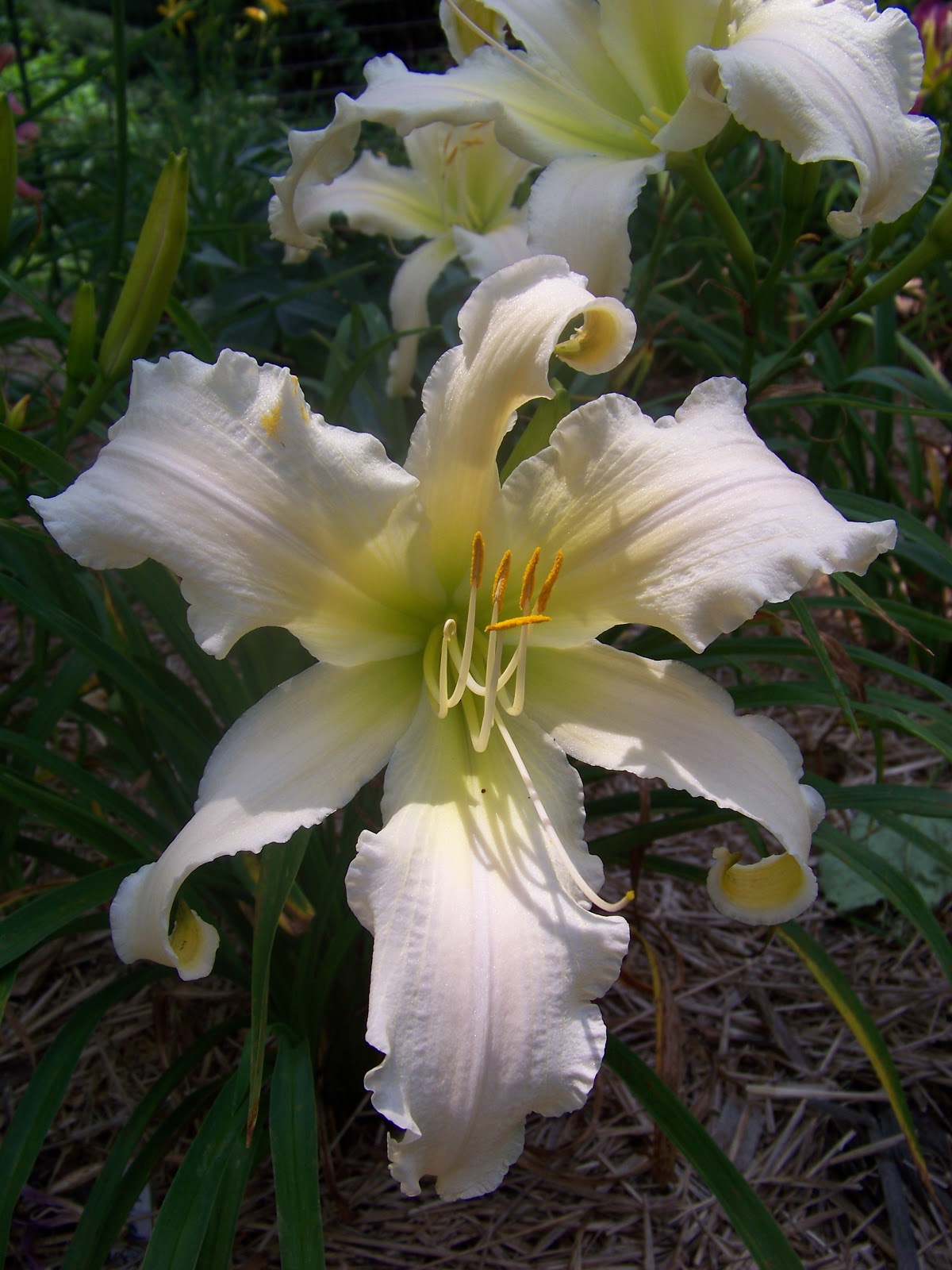
An important older cultivar that has produced some notable offspring with many of its descendants being rust resistant is So Lovely by Lenington. A near white semi-evergreen diploid that is extremely hardy and exceptionally vigorous, among its resistant offspring are Starsearch and Frozen Mert, while So Lovely's most famous descendant is the very resistant 2013 Stout medal winner, Heavenly Angel Ice. (A photo from my garden of this lovely cultivar, Heavenly Angel Ice, can be found at the end of this post.) I have been told by several persons that So Lovely is exceptionally susceptible to spring sickness, so that should be considered when using it, but this susceptibility is not shared by all its descendants, so with care, So Lovely can still be a useful breeder for rust resistance.

There are undoubtedly other family lines that have a higher than average number of individuals exhibiting resistance, just as there will also be family lines showing higher than average susceptibility to rust. More importantly, there are family lines waiting to be created by you, the breeders of daylilies, through the use of resistant cultivars that may not have as yet been well used. The ones listed above are those I am most familiar with and have both found and received the most data about, both in the university studies and through anecdotal information. It is likely that any resistant cultivar could found a family line of many resistant offspring, if that cultivar shows good breeding value for both resistance and desirable flower and plant traits.

Finally, I strongly encourage you to look at pedigrees. All three website mentioned above (Tinkers, AHS Database and All Things Plants Daylily Database) are excellent sources of information on the descendants of the lines I have mentioned above. All Things Plants will even offer rust ratings for some of the cultivars in their listing, so it can be especially helpful when researching descendants of these family lines.

A Non-comprehensive Listing of Seemingly Resistant Cultivars

About Older Cultivars - There are many more old cultivars that are known to have resistance than there are newer ones. While there are likely a good many new cultivars that have resistance to some extent, these may not be as well known for their resistance and they may not have shown resistance over the course of many seasons or in a wide range of gardens. Time hopefully will reveal those cultivars to us, but they won’t be new either by that time. To use a newer cultivar that shows resistance is good and useful but the older, more verified cultivars have an important place in a resistance breeding program, at least in the building of base lines for breeding more advanced types with resistance, for outcrossing to newer cultivars that also show some resistance and for using in salvage projects with very advanced, but poorly resistant cultivars.

About Newer Cultivars - This will be a much shorter part of the list, as there is little data available on most new cultivars. A few breeders will make mention of the resistance levels of a few cultivars, but the only person I know of who is consistently doing this with their new introductions is Ted Petit. Those cultivars of Mr. Petit’s breeding that I grow have been consistent with the resistance levels he has listed for them. I commend him for doing this and congratulate him on the effort he is making in this important area while still turning out advanced and beautiful flowers.

I am very careful about adding new cultivars, as there is nearly no way to even guess if they will show resistance or not. For that reason, I am very cautious. When I consider the prices of most new cultivars, I just am not willing to take the risk to either end up with something useless to me or another salvage project. So for new cultivars, I rely on those few reports I find or receive and those few breeders/sellers who actually mention the resistance level they have experienced with their or another’s new cultivar(s), or are willing to honestly share that information with me.

Below is a list of 150 cultivars that have shown good to high rust resistance. Please bear in mind that this is not a comprehensive list, and is just a sampling of cultivars that have some data out there about their resistance, that I have had some experience with and/or that I have also received anecdotal reports from other growers about. These cultivars may not be consistent in all settings nor will they be consistent with all strains of rust. These are not peer-reviewed findings, nor has the resistance of any of these cultivars been ‘proven’. Many have consistently shown reliable scoring over many years and in many gardens and many of them have also been shown to be able to pass their apparent resistance on to some of their offspring. This is not a complete list of all the cultivars known to show some resistance, nor is it a complete list of those I am experimenting with, but it does represent a nice mixture of ploidy, ages, colors, patterns, forms, foliage types, etc. 

There are undoubtedly many more cultivars that show resistance that simply have never been evaluated or recorded and mentioned in public, but it is beyond the scope of this series of posts to attempt to assemble a complete and up-to-date listing. Please note that these are not listed in any order: alphabetical, by resistance levels, by ploidy, flower form, color, or any other system. Finally, I am not listing a specific "rating level" with any of these, as I think such ratings are often speculative, they can vary depending on the environment and the rating under one strain of rust may be very different when exposed to a different strain. I have seen conflicting reports of exact rating levels for some of these cultivars and have also seen variations amongst their levels, but in all cases, none of these have shown above average susceptibility or have been highly susceptible in my experience or in any listing I have seen. This list is only a starting point.
  1. Jocelyn’s Oddity
  2. Lily Munster
  3. Early and Often
  4. Kanai Sensei
  5. Wild One
  6. Pack Hunter
  7. Grape Velvet
  8. Little Grapette
  9. Parallel Universe  
  10. Pretty Graphic  
  11. Mercedes
  12. Milk Chocolate  
  13. Orange You Clever
  14. Spider Miracle
  15. Debary Canary  
  16. Rosy Returns
  17. Night Wings
  18. Insider Trading 
  19. Chicago Apache
  20. Bela Lugosi  
  21. Sir Modred
  22. Velvet Eyes
  23. Pacific Rainbow
  24. Brave World
  25. Laughing Clown
  26. Wilson Spider
  27. Nanuq
  28. Heavenly Final Destiny
  29. String Bikini  
  30. Chocolate Dude
  31. Galaxy Explosion
  32. Lusty Little Lulu  
  33. Siloam Merle Kent  
  34. Untangle My Emotions
  35. Ancient Elf  
  36. Notify Ground Crew 
  37. Forever In Time
  38. Heavenly Angel Ice
  39. Dad’s Best White  
  40. Spacecoast Sea Shells
  41. Lavender Arrowhead  
  42. Mama’s Cherry Pie
  43. Spacecoast Royal Rumble
  44. Autumn Minaret
  45. Rainbow Candy
  46. Oceans Eleven
  47. Long Tall Sally
  48. Grand Masterpiece
  49. Startle
  50. Mississippi Red Bed Beauty
  51. Stare Master
  52. Clean Slate
  53. Alabama Jubilee
  54. Bill Fall
  55. Lavender Stardust
  56. Super Magician
  57. Priscilla’s Rainbow
  58. Peacock Maiden
  59. People’s Pleasure Palace
  60. Nosferatu
  61. Divertissement
  62. Trade-Last
  63. Plastic Pink Flamingos
  64. Crazy Miss Daisy
  65. Which Way Jim
  66. Persian Ruby
  67. Betty Warren Woods
  68. Mister Lucky
  69. Laura Harwood
  70. Prince John
  71. Men In Black
  72. Fortune’s Dearest
  73. Adena Inferno
  74. Long Stocking
  75. Aldersgate
  76. Lynn Penn
  77. Edna Selman
  78. Red Hat Diva
  79. Sour Puss
  80. South Sea Enchantment
  81. Ferengi Gold
  82. Coral Majority
  83. South Seas
  84. Brocaded Gown
  85. Gleber’s Top Crème
  86. Buttered Popcorn
  87. Karen Stephens
  88. Spacecoast Dark Obsession
  89. Spacecoast Irish Illumination
  90. Megatron
  91. Wild Wookie
  92. Siloam Mama
  93. Big Apple
  94. Whale Tails
  95. Love Comforts the Soul
  96. Charlie Pierce Memorial
  97. Key To My Heart
  98. Rachel Billingslea
  99. Tuscawilla Tranquility
  100. Groovy Green
  101. Green Flutter
  102. Strutter’s Ball
  103. One Step Beyond
  104. Water Drops
  105. Mint Octopus
  106. Sunday Gloves
  107. Almira Buffalo Bone Jackson
  108. Witches Wink
  109. Devil's Footprint
  110. Lady Neva
  111. Tangerine Horses
It is important to reiterate that I am not saying that any of the above cultivars are "immune". Some of them will be highly resistant in one garden, but not as highly resistant in another. Some will have high resistance to one form of rust, but less resistance to another form of rust. These should be givens, but I want to spell this out. There will be variations of resistance, not only amongst the cultivars on the list, but even with any given cultivar depending on the strain of rust to which it is exposed and the environment in which it is grown. This list is merely presented as an example, a random sampling, of cultivars showing resistance, to both give you a starting point in looking for resistant cultivars to grow and/or breed from and to illustrate that resistance is found in a wide range of cultivars, old and new, plain and fancy, tetraploid and diploid.

In our next installment, we will look at links and recommended reading.
Tuesday, January 7, 2014

Breeding for Rust Resistance in Daylilies: Part 9

Breeding for Rust Resistance in Daylilies: Part 9


In this post we will pick up where the last one left off and look at some tips and pointers I have for hobbyists, collectors and breeders who wish to pay any attention at all to the problem of rust in daylilies or who wish to pursue, actively or passively, a program of breeding for rust resistance in daylilies.

A Challenge and Invitation: Part 2

So what are my suggestions for those who would try?

Know your area and what might work for you. Obviously, if you are in the north, you can’t actively breed for rust resistance, because you are not going to consistently have rust in order to do so. If you get rust every year, but only in the fall, you still don’t have the conditions to do a full-on resistance program as would someone in the south with spring and fall rust, but if you are getting rust consistently most every fall, you can still make strides toward more resistant seedlings and the removal of the most susceptible seedlings from your population. This is a big thing and not to be underestimated, just because it is not the most extreme project that can be pursued by more southern located breeders.

However, with that said, if you are in the south and have rust nearly year round, if you spray, you can’t resistance breed, and if you only discontinue spraying in the fall, then you are creating an artificial condition that doesn’t allow you to take advantage of your location fully. That is fine, if that is your choice, but you still will not be getting the full advantage that your location offers. To take fullest advantage of near year round rust, you have to actually be exposing your plants to that nearly continuous rust cycle. Be warned, you will possibly loose plants, especially if you are in the most southern extremes of the country, but those that survive and show resistance under those extreme conditions will form the backbone of a true resistance-breeding project.

Educate yourself about cultivars. To resistance breed, actively or passively, you need to know what cultivars are already showing resistance and use them. To do this in your own collection, you must allow some rust exposure and you must evaluate your plants. Just one evaluation in a season is not really sufficient. You need to do an evaluation every week or two while rust is active to get a feel for how a given cultivar progresses through the season. While that season won’t represent ‘proof’ of a given resistance level, it will give you an indicator to work from. Another thing you can do is to talk to others who have been working with rust to find out about known resistant cultivars. You may even be able to get someone with knowledge of resistant cultivars to look over your accession list in order to point out what you have that is known to be resistant or susceptible.

To find other resistant cultivars, you need to look at the information that is out there. While there isn’t much, there is some: surveys, university evaluations, and anecdotal. Don’t discount the later. One of the most important things you can do is to talk to people, read threads on message boards, and see what people have to say about various cultivars. Ask questions! When you begin to hear the name of a given cultivar mentioned over and over by numerous people in many different locations as being resistant, take note. That one might actually be! Further, if that same cultivar also shows up on surveys and university evaluations as having resistance, it may turn out to be very usable for you.

Every report will not be found to be the same for you, but if even a few do, that will give you a basis to work from.  Finally, even if you aren’t breeding for resistance at all, you can at least know a few cultivars thought to have resistance to tell others, and if you happen to be a seller, it would be nice if you know that some of the cultivars you offer have been observed to have resistance or are susceptible so you can answer clients questions about either thing.

For breeders, listen to the reports of people growing your cultivars. If you can’t (or won’t) experience rust in your garden, this can be a valuable source of basic information to work from. I realize that these reports are only ‘anecdotes’ but they are a place to start, and if by chance you hear from several people that this or that cultivar has been resistant, there is a good chance that it is (or at least will have some level of resistance that may be usable for breeding). In time, enough anecdotes can be indicative of actual resistance. They at least give you a basis for further testing in your own garden.

Breeders please do publicize your observations and the received (anecdotal) reports of your customers. This is a point I think is important to make. Your anecdotal evidence, when added with that of others, is important. If you have observed a cultivar showing resistance or immunity or susceptibility, tolerance or lack of tolerance to rust, then those observations matter, and if by chance you have observed the given results repeatedly over the course of some years, it has even more weight. Now I do think it is important that you not treat your observations as absolutes. You don’t want to say, “I have proven that so-and-so is resistant or immune or whatever because it has been so in my garden for x# of years”. That is too definite, but to say that, “So-and-so has shown resistance or immunity or susceptibility, etc. in my garden (and in X# of my customers gardens, etc) during X# of years”, is perfectly acceptable, because you are making no absolute claims. You are not saying something ‘is’ this or that, but that is ‘has performed as’ during a given time in your garden (or other gardens you have been told about) for a given time period. 

You should also then report variations, so that if a given cultivar was strongly resistant for three years, then had a susceptible year (possibly another strain of rust?) then had a resistant year, you are not making absolute claims, but rather are offering your observations. If you want, you can also add a disclaimer that your observations are yours alone and may not reflect performance in other gardens.  Be clear, but pass on what you have observed. Just because the topic is ‘rust’ doesn’t mean it should be treated any differently than any other trait we select for. After all, many of you report your observations of say bud count and branching, even though we know they may not be the same in another garden in a different environment...

I don’t know of anyone in the daylily world who is afraid to make ‘claims’ or share their experience of things like branching, foliage type, fertility, breeding influences of a given cultivar on pattern, color, emo, or any other flower traits. Rust is not any different. The long wait for “proof” along with the scientific bludgeon of ‘unscientific’ has resulted in far too many hobbyists keeping quite about their experiences with rust and their observations of given cultivars. Imagine what the daylily world would be like if we treated every trait we select for with that same delicacy.

Now, I have to admit that I understand fully why so many clamor for ‘proof’ and why researchers have been skeptical. The claims of ‘rust resistance’ could easily be exploited for financial gain by the unscrupulous. It would be very easy for someone to have popped up and claimed rust resistant strains with no proof and have been claiming a premium for that claimed resistance. It is to the credit of the daylily world and a reflection of the honesty of the great people in the daylily world that this didn’t happen.

I would also add that I don’t see ‘rust resistance’ as being a trait to command a special premium. I think it is just another trait that daylily breeders need to be selecting for, where they can. I do think we need to be more open about our experiences, preface that they are merely our experiences and share those, letting go of fear of censure or attack as well as the prospect of our observations being ‘trade secrets’ that can eventually enrich us. We need to be sharing our knowledge and working to improve the plant we all love.

Be realistic about what you can do, but try to do something, no matter how small. Not every breeding program needs to be focused on the ultimate goal of 100% immune cultivars. That would be a worthy goal and a great thing to work toward, but to make that your expectation will likely lead to disappointment rather than a garden fully of nothing but rust immune seedlings. It seems inevitable that in time some researcher(s) may discover the gene(s) that offer both resistance and even full immunity to rust and from that, may be able to create cultivars (or even true breeding lines) of cultivars from those genes, but hobbyists, out in the trenches breeding by sight and experience, do not have the advantage of labs and funding, so we must proceed from a point that, while less controlled, can still give good and useable results, and even the best lab identification of a given gene offering rust immunity or resistance probably won’t apply to every strain of rust. So in that regard, whether in the lab or simply in your garden, all things are fairly equal in the sense that there is likely to always be a race against new strains of rust that make our old resistance genes obsolete, partially or totally. This has certainly proven to be the case in the examples of rust and rust resistance in other species.

For that reason, I don’t think the notion of waiting for the experts to ‘fix it’ is all that viable, and further, if someone does come along and introduce a ‘proven rust resistant’ strain, you can always breed those into your own lines. In effect, you are making preparations for the day when such ‘proven’ lines might become available. Just remember that no line of ‘proven resistant’ plants, mine, yours or those from a lab, are likely to remain that way forever, in the face of the constant evolution of new strains of rust. For this reason, I think a more realistic goal, and one fraught with far fewer pitfalls and less heartbreak, is to focus on good to high resistance with high tolerance to rust and the combining of many genes for resistance in the hopes of weathering the onslaught of many different strains of rust over time. Yet while this is my realistic approach, you should find yours.

At any rate, doing almost anything is better than doing nothing. What is realistic in the Far North is not realistic in the Deep South, and vice-versa. The important point I want to make here is that if we set the bar too high (a common failing in most places and endeavors), we almost invariably set ourselves up for failure. As I have pointed out in this series before, most gardeners and breeders aren’t too bothered by a bit of rust. It is the heavy rust coverage of the low resistance/highly susceptible cultivars as well as its negative impact on performance (and in some case survivability) that creates the most distress and the most severe problems we encounter with rust. In my view, the most realistic goal is to begin to move the genome of the genus toward resistance and away from susceptibility, and we can each make a contribution in whatever way we can, at whatever level is suitable to our location, situation, inclination and interest.

Remember that selection for rust resistance is just another form of selection, another trait amongst many you select for already. I can’t stress this enough. Yes, rust may have been a big, scary freak-out when it first emerged, and it may create the same response when you first have it in your garden, but by now we know that (except in a few very southerly locations) rust is not the end of the road. So now, rust is just another ‘problem’ many of us deal with, just like low bud counts, melting pigments, ugly foliage, etc. Consequently, resistance to rust is now a factor to select for, as any other. Don’t get too extreme (unless you just really want to or are in a situation where you can) and do what you always do for any other trait - make selections.

While that will not be considered a ‘resistance-breeding program’, you will be making your own small contribution and thus making a difference, even if only in a small way by simply removing the most rust susceptible. At the very least, you will be paying attention to your own plants and learning what shows the desired tendencies in your own garden. Beyond that, you can choose any level of project you want to pursue, setting your goals as low or high as you want. You just need to arm yourself with information and be prepared to make an extreme effort should you choose an extreme goal. In the end, whether simple or extreme, your goals will revolve around selection.

Have confidence! Nothing beats confidence for getting you through uncertainties. It is true for anything we do. Don’t have unrealistic confidence, but do know that you can increase the levels of resistance in your breeding projects. There will be naysayers who want to convince you that you can’t succeed. They could have any number or reasons. Those reasons aren’t important. What is important is that you stay focused on what you have chosen to do within your own breeding program. Remember, there are no ‘daylily police’ out there to force you to follow their dictates in your breeding program. If you let peer-pressure derail you from your goals, that is not really the fault of those others.

It will not be uncommon to encounter other hobbyists who want you to believe that resistance breeding is just beyond hobbyists abilities, way too hard to accomplish, something that can’t be done, there is no ‘proof’ for and just not important - just spray and don’t talk about silly pie-in-the-sky things like “resistance breeding”. On the other hand, you will encounter science types who are just as eager to derail your efforts. Now don’t get me wrong, I consider myself an amateur scientist and I work closely with PhDs and have for many years, but scientists, like all people, run the gambit from gleeful and light-hearted to dour and negative. That is human nature, and (even if they don’t all believe it) scientists are just humans too, with all the foibles and failings that implies. However, scientists will have a special set of tools for discouraging you.

First, they can use big words, talk over your head and generally make you feel stupid. They can use their favored bludgeon of declaring your efforts to be ’unscientific’. This can make you doubt yourself and your efforts, but you need to be very clear on what ‘unscientific’, as they use it, really means. While there may be a variety of meanings, it is generally meant that what you are doing doesn’t meet current scientific standards that would be used in a university or industry setting. What it doesn’t mean is that you can’t still be applying science in a more basic sense. You can use the scientific method without meeting current peer-review standards. After all, if your goal is merely to breed as a hobbyist, no matter how lofty the goal, why do you possibly need to meet peer-review standards?

The scientific method has four major points or procedures:

  1. Formulation of a Question
  2. Background research and formulation of a hypothesis
  3. Testing the hypothesis through experimentation
  4. Analysis of results

While these four procedures alone will not merit a project as ‘scientific’ by current industry and professional standards, if you are using them in your work, it is not ‘unscientific’, regardless of what anyone tells you. You don’t have to be preparing for peer-review in order to use the scientific method in your breeding program. Your goal is to increase the levels of rust resistance in your seedlings, not to ‘prove’ that it can be done to peer-review standards.

Finally, I would again point out that our ancestors managed to accomplish a great deal without any scientific understanding - they turned teosinte grass into corn (maize), wild triticum grasses into wheat, bitter and inedible wild potatoes into the modern staple, jungle fowl into chickens and wolves into dogs, just to name a few. What we seek to do in increasing the level of resistance to rust in our daylilies (a resistance that already exists within the overall daylily genome) is not nearly as radical or extraordinary as what our ancestors achieved before us, and we have much better tools at our disposal to achieve this.

Have confidence! There is already resistance to rust within some daylilies. The genes are there. We don’t have to find the genes - we already have some indication where to look. We don’t have to genetically engineer resistance - it exists in some plants within the population. All we actually have to do is identify it, concentrate it and compare it against various strains of rust. Not any one individual has to do all these things either. It is a job for the entire community of daylily breeders to do, so no one of us must carry the entire weight. Remember that the worst thing that can happen is failure and it is important to remember that if you do fail at increasing the level of rust resistance in your program the world won’t end, markets won’t collapse, civilizations won’t fall. Don’t get so serious that you give yourself an ulcer over a flower. While we daylily breeders don’t like to admit it, if worse comes to worst…there are other flowers…or we can learn to ignore some rust.

Finally, I would like to point out that belief creates your reality, in the sense that, if you believe you can’t select for resistance, then you will never try and it will thus be a self-fulfilling prophecy. What you never attempt, you will never achieve!

In the next installment we will look at some daylily family lines known to show resistance and a random listing of some cultivars that have shown resistance.


Friday, January 3, 2014

Breeding for Rust Resistance in Daylilies: Part 8

Breeding for Rust Resistance in Daylilies: Part 8

This section will be split into two posts as it is rather long at nine typed pages.

A Challenge and Invitation: Part 1

This section might better have been titled ‘Ramblings’, because I will be doing just that; covering various points that don’t conveniently fall into any of the previous categories and while pointing out various options open to the hobbyist breeder. We have covered many topics in some small detail and I hope by now you have a good overview of rust, resistance breeding in general, how rating and evaluation may be done and a more realistic understanding of what may be possible or desirable. There are many other minute topics we could look at but that don’t merit a full posting at this time.

Rust is a reality and will likely continue to spread. There seems to be no way around that. While it would be nice to wait until there is ‘scientific proof’, “real data” as I hear many people say, the truth is that we may be waiting until we are very old to start, if that is the criterion we hold for a beginning point. Science, of necessity, moves at a slow pace. It must, because science is looking for proof and only repetition of data can provide proof and that takes time. 

However, for science to take the level of interest that can give us proof there will have to be an economic incentive that will cause industry to finance a university or other researcher(s) in a project to obtain ‘proof’. To date this hasn’t really happened (not to any level that will help us start a breeding project on ‘proven facts’), nor is it likely to happen any time soon, because daylilies just don’t have the economic force to justify it to the money people (industry). Now some may make a pretty penny on their daylilies, but compared to real commercial species such as petunias or maize, daylilies are a tiny drop in a huge ocean and mainly benefit a handful of hobbyists, rather than any large sector within the overall plant industry. With that being the case, I would strongly advise you not to hold your breath waiting on a study to answer all the questions and give you ‘permission’ to proceed.

In short, industry has little to no reason to care about our daylilies, and the type of research project that would be required to give us a solid grounding of proof to proceed from is going to be very expensive and no scientist can do such a project without grants and financial backing. So unless we have a secret daylily hobbyist who is a billionaire and wants to privately fund such a study out of the goodness of his/her heart (and then make the results available to us all for free and not try to keep them as trade secrets to benefit from personally), the chances of this happening seem small. 

Now, before you start sighting studies to me, I would point out that all the studies done so far have been small and have provided us with little practical and applicable information. The kind of information that a hobbyist can use in breeding is rarely what a researcher will be interested in, and vice-versa, their interests rarely translate to an average hobby enterprise. The studies we have seen so far have given us some indications, a finger pointing us in a direction, but little more.

The recent confirmation that there is more than one strain of rust is helpful, for instance, but the researchers didn’t give us any information to practically breed for multiple strains, nor do we have any way to conveniently identify various strains in our own garden. The notion that there wouldn’t be multiple strains of rust, to me, stretched credulity to begin with so all that project gave to me was ‘proof’ that there were multiple strains - something I already knew would be the reality based on the fact that everything evolves over time and all other forms of rust occurring in any other plant species evolves into multiple strains and rather quickly at that. The possibility that there weren’t multiple strains of rust seemed highly improbable, to me. So I would say that “waiting for proof” is just a way to not bother with resistance breeding: an intelligent sounding cop-out, much like throwing ones hands up in the air and screaming “But I can’t, there’s no proooooooooof!” and then proceeding to do nothing with a convenient excuse.

There is good evidence of what is possible. However, this will fall into the dreaded realm of ‘anecdotal evidence’, which has somehow been turned into something akin to old-wives-tales, flat-earthers and conspiracy theories: pseudo-science. Yet, ‘anecdotal evidence’ is not pseudo-science. It isn’t really science, nor does it need to be. No, it won’t pass a peer-review, but it can be reliable, especially when there is a large body of anecdotes that all are pointing out the same thing. The preposition that ‘anecdotal evidence’ is useless is just another convenient cop-out for those not willing to do anything, sort of a shield for inaction.

When many anecdotal reports are reviewed, common threads can be discovered that can lead to the discovery of actual facts, the so-desired ‘proof’. Many scientific studies have been done, and breakthroughs have occurred, because someone listened to anecdotal evidence and then built a study to prove or disprove what they were being told. In a court of law, ‘anecdotal evidence’, eyewitness testimony, can put you on death row, so why do we think it should be utterly ignored in every other facet of life? For my part, I believe in ‘proof’ when it is available, but when it is not, I begin by looking at anecdotal evidence to see if I can find common threads, recurring themes, from which to proceed with my own experiments in breeding. Anecdotes may not be peer-reviewable, but they are not lies, falsehoods or fantasies in all cases either, probably in most, especially when we are dealing with fairly down-to-earth subject matter like plant breeding.

Resistance breeding is not some new-fangled science that just came about in the last twenty years or so. It isn’t quantum physics. In fact, our ancestors have been practicing resistance breeding since the very first domestication events of both plants and animals. You may ask how did they do this? Well, very simply: when a disease ravaged their crops or flocks, if there were any survivors who could reproduce, they became the parents of the next generation. That is resistance breeding in a nutshell. In less dramatic instances, the poor performing individuals (in instances where diseases didn’t kill but only impaired) were removed from the gene pool through culling. Sometimes environmental circumstances alone created a drive toward greater vigor and resistance, and this was all occurring without any scientific knowledge (as we now know it) and without any peer-reviewed papers telling them they could do this. 

Now don’t get me wrong. I am not saying that the peer-review process isn’t important or valid. It is. I am only saying it is not that important or valid to the act of hobbyist breeding. That is why I went out of my way in the beginning of this series to specify the differences between the two things. We as hobbyist breeders are not looking for peer-reviewed ‘proof’, but rather for results and there is plenty of anecdotal evidence out there to show us that breeding for resistance to rust in daylilies is possible. All we have to do is actually do it.

I would also stress that I don’t think this should all be codified. There should be no absolute rules to how this is done, beyond the known facts of resistance breeding and genetics in general, and each person needs to find the level where they wish to work, for themselves. There is a large amount of data available about resistance breeding in many plant species and against many pathogens. It isn’t specifically about daylilies, but it is imminently applicable to daylilies. One thing I would not like to see is an enforced code that states that resistance breeding has to be done one certain way. There will be nearly as many approaches as there are breeders pursuing the goal. 

I have often heard criticism of the American Hemerocallis Society for not ‘doing more about rust’. I wonder though if their fairly hands-off approach has not been a blessing in the long run. I say this because I would be very leery of set parameters of ‘acceptable resistance’ or ‘acceptable breeding styles’ that were codified. To me, the truth of the matter is that rust is too vast and complex a problem for AHS to have dealt with it effectively and when I hear people proposing that they should have, I actually hear, “Why didn’t someone else do all the leg work so I don't have to?”

I cannot imagine the type of project AHS could have pursued (financially or practically) that would have tested all daylily cultivars against rust resistance, and if they didn’t test them all, then which ones would they test? Who decides? They would have needed to run those tests for many years and in multiple locations to arrive at enough data to make a determination of ‘proof’, and how would they have tested them against all strains of rust? I see the notion that AHS could have ‘done something’ as a simple lack of knowledge of what it would really take to ‘do something’, and then I would turn around and ask the person asking that question, this question- “What are you doing?” 

For AHS to put their name on any claims, those claims would need to be vetted and proven, and we have discussed proof here in previous posts. It would take years and lots of money to make such determinations, and then a new strain of rust could come along every year and destroy their well-vetted ‘facts’. I therefore feel that dealing with rust, breeding for rust resistance or not, falls firmly at the feet of the breeders. The fate of all domestics has always fallen at the feet of the breeders, in the end. Why would the daylily be any different? Scientists can help us, but we can’t expect them to swoop in with all the answers. Organizations designed for registry and promotion are not capable of the kinds of projects that could make hard and fast determinations that we might want, so who else is left to do this, if not we the breeders?

The truth is that there is no group more imminently suited to this work than the people who are breeding the plants. We are out amongst them; we participate in their reproduction, choosing their partners and raising their offspring. We select them for every criterion imaginable, culling millions each year, but we feel others should give us the ‘fix’ for this problem? I think that is fear and laziness talking. We say we don’t know how, don’t know where to begin, don’t know what would work, but the information is out there. Resistance breeding in plants is a well known and much-written-about subject. 

Furthermore, there is a great deal of anecdotal, gathered information about breeding for rust resistance in daylilies. You just need to listen to those who are doing it, rather than listen to the fear-mongers who insist it can’t be done, most likely because they don’t want to bother with doing it or are afraid to try (or more likely afraid of trying and failing, or perhaps of just having to shift their focus for a generation or two). All you can do is ignore the naysayers and proceed. If you fail, you are no worse off than you are now, and all the evidence points to those who try being somewhat successful.

In the next post we will pick up where this one left off and look at some tips and pointers I have for hobbyists, collectors and breeders who wish to pay any attention at all to rust resistance in daylilies.